









By James Borrowdale
LIKE apartheid South Africa, I kept hearing. For a long time, the horrors behind the curtain thrown up by South Africa’s racist government weren’t widely known in this country. It wasn’t until the 1981 Springboks tour that the small band of activists, who had all the time been committed to the cause, were able to turn that affair into a nation-splitting episode—and to put increased international pressure on the regime.
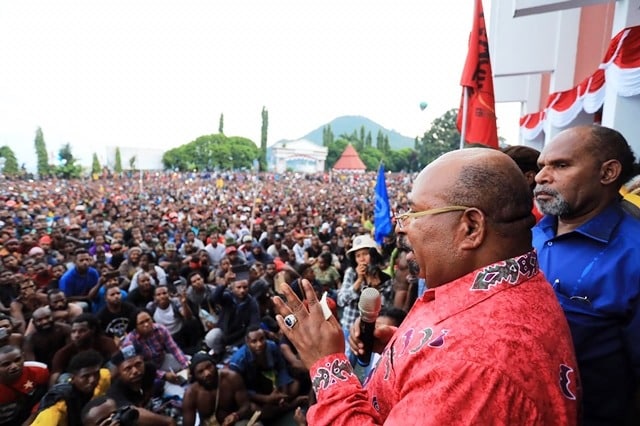
West Papua hasn’t had its Springboks tour yet; it is often called the world’s forgotten occupation. Indonesia has held formal control over West Papua since 1962’s New York Agreement granted the South East Asian superpower the former Dutch colony, with the promise of a fair vote on self-determination by 1969. That never arrived: 1969’s Act of Free Choice, in which just 0.2 percent of the population voted—under extreme duress—determined that West Papua was to remain part of Indonesia, a country with which it had no linguistic, cultural, or racial links.
Ever since, the repression of the indigenous population has been ruthless. The figure of 100,000 people killed by Indonesian security forces is commonly cited, but estimates run as high as 500,000. Mass killings of Papuans in the tribal highlands in the 1970s met the criteria for genocide, the Asia Human Rights Commission reported. And the brutality continues: a 2016 report conducted by the Archdiocese of Brisbane titled We Will Lose Everything contains reports of atrocities committed throughout 2015, including extrajudicial executions, torture, and firing on peaceful protestors. Methods of torture, another reportclaims, include rape, slashing with bayonets, and electrification.
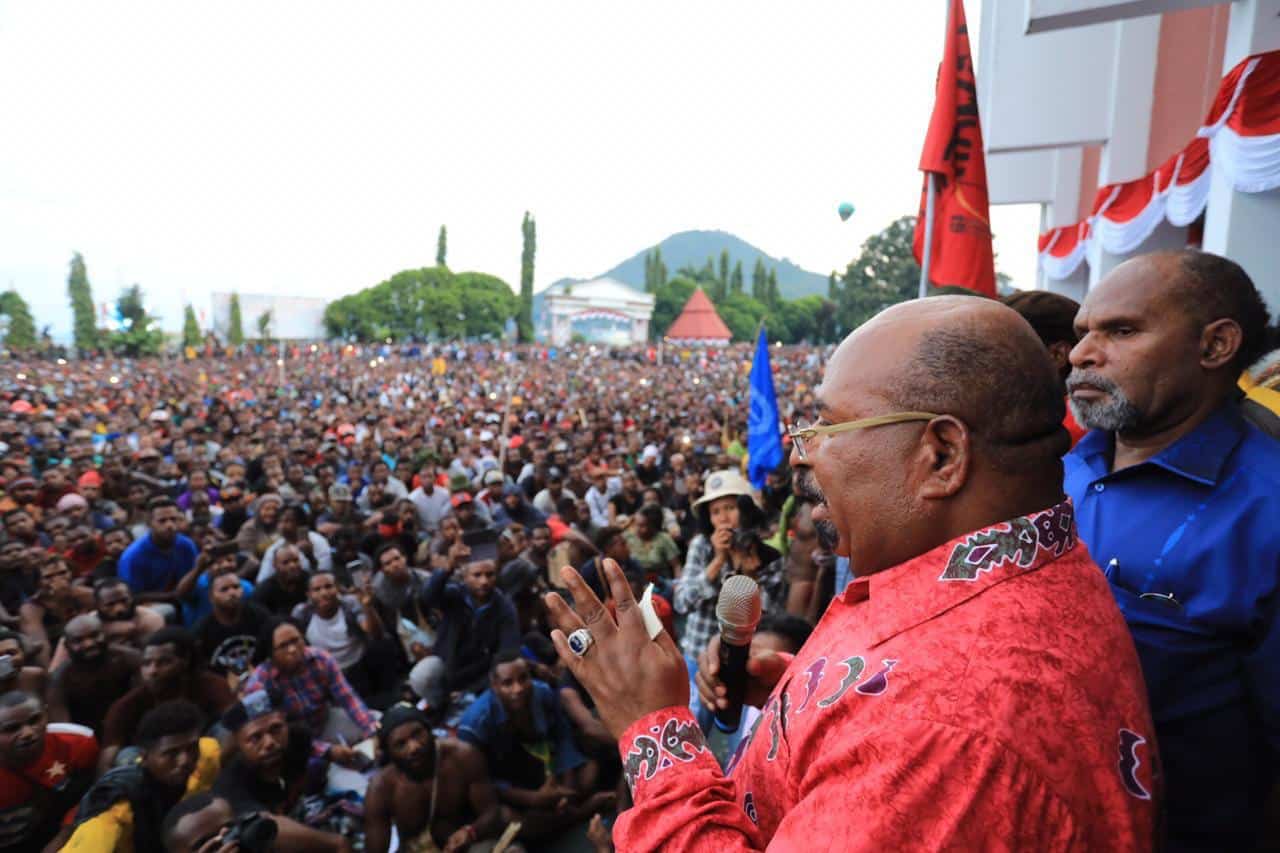
Clearly, something horrific is happening—and has been for a long time—in the South Pacific. New Zealand’s response? Successive governments, perhaps wary of aggravating an important trading partner, have refused to dispute Indonesia’s territorial borders. The media hasn’t done much better—VICE NZ was one of just a handful of outlets to cover a visit to New Zealand by Benny Wenda, the leader-in-exile of the West Papuan independence movement and a man twice nominated for the Nobel Peace Prize, earlier this year.
He’s a man with a fascinating tale to tell—a childhood spent on the run in the bush, horrors witnessed, arrest, escape, a life-long commitment to the cause of his people. And it’s a story that is percolating at some political level, with 11 New Zealand MPs across four parties now signatories of the International Parliamentarians for West Papua declaration. Where, then, I wondered, were the profiles in the Saturday newspapers, the coverage on Sunday-night current-affairs shows?
Dr Pala Molisa, of Victoria University’s School of Accounting and Commercial Law, is a long-time supporter of West Papuan independence. Addressing why the New Zealand media is reluctant to take on the story of the subjugation of an entire people, happening so close to home, he says, means confronting an “uncomfortable thing”. “It shouldn’t be too controversial [to say] today that black and brown lives, when you look at the patterns—socioeconomic, police shootings, mass-incarceration—are devalued when compared to white lives.”
Molisa is from Vanuatu, a country that also had to fight for its independence from colonial rule. He bemoans how dependent Pākehā awareness is upon coverage in established media: “Most of our educated Pākehā population is highly reliant on mainstream media. As long as [West Papua is] kept out, that’ll affect the amount of participation.”
Professor David Robie, director of the Pacific Media Centre has, as a journalist, been reporting on West Papua since the early 1980s, and finds the lack of interest “puzzling”. A veteran journalist (“I think I’ve got a reasonable handle on what is international news”), he wonders why the majority of the press has for so long largely ignored West Papua.
“It has so many elements that have resonance with New Zealand—indigenous issues, land issues, development issues. And in the past we’ve had an affinity with the people of the Pacific, going right back to the nuclear-free policies, which were very intertwined in Polynesia with indigenous self-determination.”
In the wider Pacific, at least, there is some momentum gathering. In March this year, seven nations—Vanuatu, Tonga, Tuvalu, Palau, Nauru, the Marshall Islands, and the Solomon Islands—addressed the United Nations Human Rights Council in Geneva, raising concerns about human rights abuses in West Papua.
“Within their suffering we see our own”
Māori, too, have been vocal about West Papua. When Wenda visited Auckland, he was welcomed onto Ōrākei Marae by Ngāti Whātua. Wayne Pihema, a Ngāti Whātua Board Trust member who helped organise the hui, says shared experiences of colonialism motivated the invitation to Wenda to speak. “We’ve got somewhere in our genetic history a memory of that kind of experience… We can relate to people in West Papua as being part of the Pacific and being indigenous Pacific people like us. Within their suffering we see our own.”
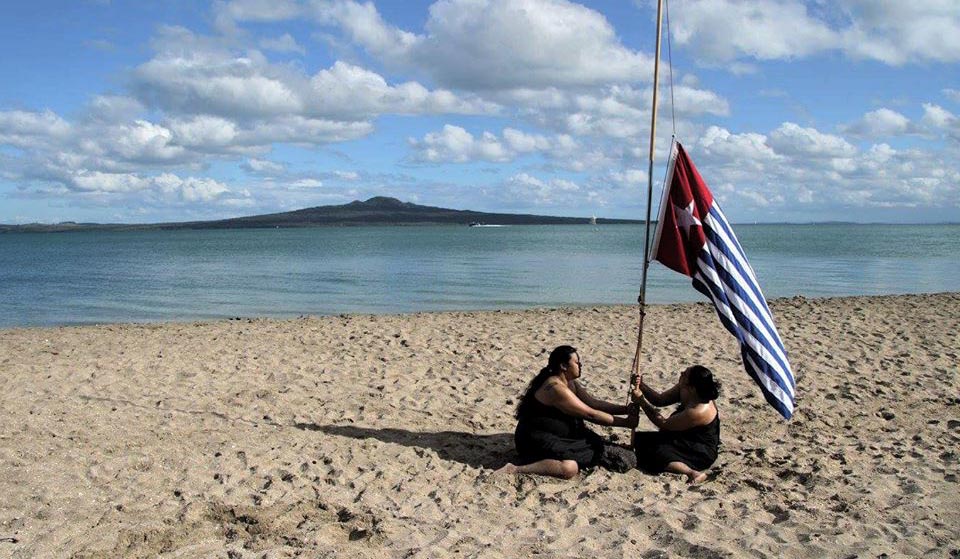
Oceania Interrupted is an Auckland-based group of Pacific and Māori women who use visual and performance art to raise awareness of the suffering of West Papuans. The group, which has included women from as many as 13 different Pacific ethnicities or nations, has staged 10 of the 15 “artistic interventions” it plans to hold—15 years being the mandatory prison sentence for raising the West Papuan Morning Star flag within the Indonesian-occupied territory.
In a similar fashion to Pihema, spokesperson Leilani Salesa calls the group’s duty to West Papua an “ideological commitment”, one borne of a sense of Pacific solidarity. “ he ocean is what binds us together, the ocean is our sea of islands… the ocean is what our ancestors conquered.”
Salesa, though, highlights the role that Pākehā activists have played in raising awareness, singling out veteran campaigner and writer Maire Leadbeater: “If it wasn’t for her, I wouldn’t know who I know and what I know.”
I put it to Leadbeater that Māori and Pacific groups within New Zealand are now taking the lead, something she said was “amazing”. “I see it in the context that the interest in West Papua has extended so much through the Pacific recently. Communities here are linking up with really strong movements in the Solomons and Fiji, and to some extent in Tonga and Samoa, and so on. It’s really important people here are getting engaged because they are in touch with their families in those countries, and it’s those countries that are actually taking action at the moment—it’s not New Zealand, unfortunately.”
While it’s great, Leadbeater says, that impetus comes from Māori and Pacific communities, it’s important there is wider—and whiter—support. “Look at the tino rangatiritanga movement in this country: it’s always had strong allies in the Pākehā community, hasn’t it? And that’s always been important to the success of campaigns.”
“The anti-apartheid activists would’ve felt like they were just spitting into a cyclone…you just need to keep having faith.”
She remains upbeat about the effect protest and public opinion have on government action, citing her previous research that, she says, proves the Government is attuned to public opinion on Indonesian activity, especially as it has related to atrocities committed in East Timor and, to a lesser extent, in West Papua. “You think the Government is not taking any notice, but they do have to take account of public opinion and the stronger it gets the more they have to take notice. [But] you can’t expect people to identify with an issue they’ve hardly ever heard of.”
Molisa, too, is optimistic. “What gives me faith, to put it in that historical perspective, is that this is in the early stages, and the anti-apartheid activists would’ve felt like they were just spitting into a cyclone. If you look at the long arch of history, that tells you that you just need to keep having faith because these sorts of things have a way of building in ways you can’t expect.”
James Borrowdale is a Journalist at VICE, New Zealand