









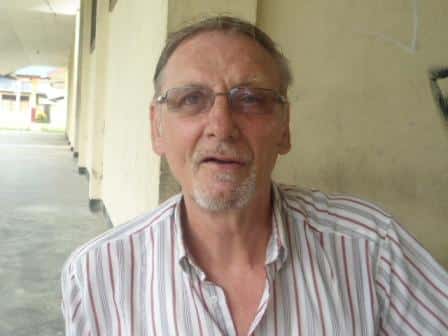

Even though his Dutch is still as fluent as ever, it is doubtful whether Theo van den Broek (70) can still be called a Dutchman. After spending 40 years in Papua (Indonesia), he has a new homeland.
“I went to Papua as a missionary Franciscan brother. I have never stopped working with the people in Jayapura and other places, standing side by side in their struggle for political, economic and social justice. In Papua I became the person I am today and Papua will be the place where I will die. I am no longer a Franciscan brother – I have married a Papua woman – but I have never dissociated myself from the social mission of the Church in Papua.”
Over the years van den Broek has developed an intense and intimate connection with the people of Papua, first as a missionary brother and later as the lay man he is today. It is this connection that embodies the essence of how he looks at the concept of ‘caritas’.
In 40 years’ time he witnessed how this connection between church aid worker and the community he serves has changed drastically, and not always for the better.
Isolation and connectedness
Theo said, when he came here, back in the ‘70s, missionaries came from far away and settled in extremely isolated communities, deep in the interior. “Where public transport stopped, you had to walk through forests and marsh land. Though I coordinated social work of the diocese of Jayapura, and stayed in the provincial capital, I visited many of the outposts”.
Communication with the outside world was difficult then. Twice a day, there was an SSB (Single Side Band) radio connection. Today, communication by road and by internet has greatly improved. It means that even in the smallest village you are better connected to the world, to your family. But it also means that the connection you feel with the people you have come to serve can become less personal, less intense, and less strong.
Besides that, most of the missionaries who come to Papua today come from other parts of Indonesia. “They have, naturally, a more Indonesian perspective on Papua, which is different,” he said.
From the beginning, van den Broek recognizes the sensitive political aspects of the social work the Church engages in and urges church authorities not to turn a blind eye to issues of justice.
“When Papua was integrated into the Indonesian nation in 1963, the local population had no say in the process. Up until today they feel neglected, by Indonesia, by the Dutch, by the US. For them aspects of poverty and underdevelopment, which are huge, cannot be dissociated from the political injustice they experience and their struggle for self-determination. Of course, neither the church nor I ever took sides in this struggle for independence. But I have always defended the people’s right of self-determination. And I have always insisted with church leaders, that church building and missionary work includes the politically more difficult and sensitive struggle against injustice.
During my years as head of the Human Rights Commission of the Jayapura diocese, until 2005, I managed to convince the church of this. Personally, it was totally impossible for me not to speak out against the many cases of discrimination, arrests, murders and disappearances.”
Caritas against all odds
For van den Broek, in essence ‘caritas’ means staying with the community you have come to serve and allowing yourself to become a part of that community.
Whatever the odds. “Ever since Soeharto there has been an organized influx or transmigration of Muslims to Papua, to the extent that the local mainly Christian population has become a minority today and has lost all economic and political control over their own lives. We have always stood up and spoken out against this marginalization.
Of course Indonesian authorities and the army didn’t ‘like’ this. Some of my colleagues and myself, we were blacklisted as being ‘anti-government’ and ‘anti-nationalistic’. Essentially what they told us was to ‘shut up’. What can you do in that case? For a couple of days I changed my modes of transport, looked around more carefully. But then again, if they want to find you, they will, whatever measures you take.”(*)
Necessity to act
Van den Broek’s full time involvement in the church’s human rights work started in the mid ‘90’s, on a day a small group of villagers desperately wanted to speak to the bishop, but the only one present was van den Broek.
“They had travelled from far. They didn’t know who to turn to anymore. People in their village had been shot, others had been beaten up, locked up in containers… They were desperate and wanted to talk to the bishop, who wasn’t there. There and then, as head of the Diocese office at that time I transgressed the limits of my formal authorities and I decided to investigate the human rights violations they shared to the fullest.
Anyway, after I communicated with the bishop, he agreed most heartly with my decision. This resulted in the first human rights report ever to be published by the Church in Papua, in 1995. I knew this was politically very tricky and sensitive. But at the moment the villagers confronted me, a few essential things coincided. There was the immediate confrontation with the sufferings of the people in front of me; there was the decision I had once taken to be at the service of the people in Papua; the knowledge that you are part of the Church and that this gives you a position that you can influence things. There was my own spirituality as a Franciscan, my option for the poor, that allowed me to be touched and disturbed by the eyewitnesses. All this resulted in feeling of solidarity and responsibility and a necessity to act.”
Risk aversive
The moral necessity to act and to speak out, as an expression of caritas… Van den Broek points out that it is increasingly difficult to do fulfill this commitment as a church organization. “The new pope is a true inspiration. But narrow financial ties of the church with the national government and with the corporate industry pressure social organizations of the church not to be too critical, to be risk aversive and not to speak out loudly against social and political injustice. And the shift the Church took under Benedictus XVI to pay more attention to devotion and less to societal issues, hasn’t helped either.
That’s why a conference as this one here in Vught can help us to feed and strengthen our own spirituality of caritas, to deepen our connectedness to the sufferings of others and to make sure that human rights and justice remain an essential part of the Church’s pastoral work.”
New elites, more migrants
When van den Broek analyzes Papua’s current situation, he comes to the conclusion that the huge amounts of government spending and the legislative efforts to regulate the autonomy of Papua have not improved the lives of the common people of Papua.
“Unfortunately national Indonesian budgets for Papua, meant to develop the province, have created a Papua elite that has enriched itself with government money and enhanced internal tensions. On top of that these riches have only attracted more migrants. So even though there is an autonomy law for Papua since 2001, the discrimination against the local population, which has now become a minority, has only increased.”
No need for big cathedrals
Today van den Broek is an independent aid worker. In the past 10 years he worked for several NGOs in Papua as well as Eastern Timor, often in management positions. At the age of 70, after 40 years ‘in the field’, his main message to professionals and organizations who strive to work in the spirit of caritas is ‘to live and to stay with the people you serve’. Van den Broek: “There is no need to build big cathedrals or to appoint high level church officials. Just live with the people, stay for longer periods of time than just a few months, listen carefully to what they share with you and base your efforts of development and justice upon their knowledge, their experience and their sufferings.”(*)
Sources: cordaid.org