










By : Simon Wood
LEADER of the UK’s Labour Party Jeremy Corbyn last month drew attention to the long-suffering and ignored people of West Papua, stating that ‘recognition of human rights and justice should be the “cornerstone” of the UK Labour party’s foreign policy’. He was addressing a group of international ministers and activists, including West Papuan independence leader Benny Wenda. The Indonesian embassy in Australia released a statement dismissing the meeting as a publicity stunt organised by a “small group of Papua separatists and sympathisers”.
Declassified documents published in 2004 by the National Security Archive ‘detail United States support for Indonesia’s heavy-handed takeover of West Papua despite overwhelming Papuan opposition and United Nations requirements for genuine self-determination’.
When Indonesia gained its independence from the Netherlands in 1949, the Dutch government retained control over the territory of West New Guinea. From 1949 until 1961 the Indonesian government sought to “recover” West New Guinea (later known as West Irian or West Papua), arguing that the territory, a part of the former Netherlands East Indies, rightfully belonged with Indonesia.
In late 1961, after repeated and unsuccessful attempts to secure its goals through the United Nations, Indonesia’s President Sukarno declared a military mobilization and threatened to invade West New Guinea and annex it by force. The Kennedy administration, fearing that U.S. opposition to Indonesian demands might push the country toward Communism, sponsored talks between the Netherlands and Indonesia in the spring of 1962. Negotiations took place under the shadow of ongoing Indonesian military incursions into West New Guinea and the threat of an Indonesian invasion.
The U.S.-sponsored talks led to the August 1962 New York Agreement, which awarded Indonesia control of West New Guinea (which it promptly renamed West Irian) after a brief transitional period overseen by the UN. The agreement obligated Jakarta to conduct an election on self-determination with UN assistance no later than 1969. Once in control, however, Indonesia quickly moved to repress political dissent by groups demanding outright independence for the territory.
U.S. officials understood at the outset that Indonesia would never allow West Irian to become independent and that it was unlikely to ever allow a meaningful act of self-determination to take place. The Johnson and Nixon administrations were equally reluctant to challenge Indonesian control over West Irian, especially after the conservative anti-Communist regime of General Suharto took over in 1966 following an abortive coup attempt which led to the slaughter of an estimated 500,000 alleged Communists. Suharto quickly moved to liberalize the Indonesian economy and open it to the West, passing a new foreign investment law in late 1967. The first company to take advantage of the law was the American mining company Freeport Sulphur, which gained concessions to vast tracts of land in West Irian containing gold and copper reserves.
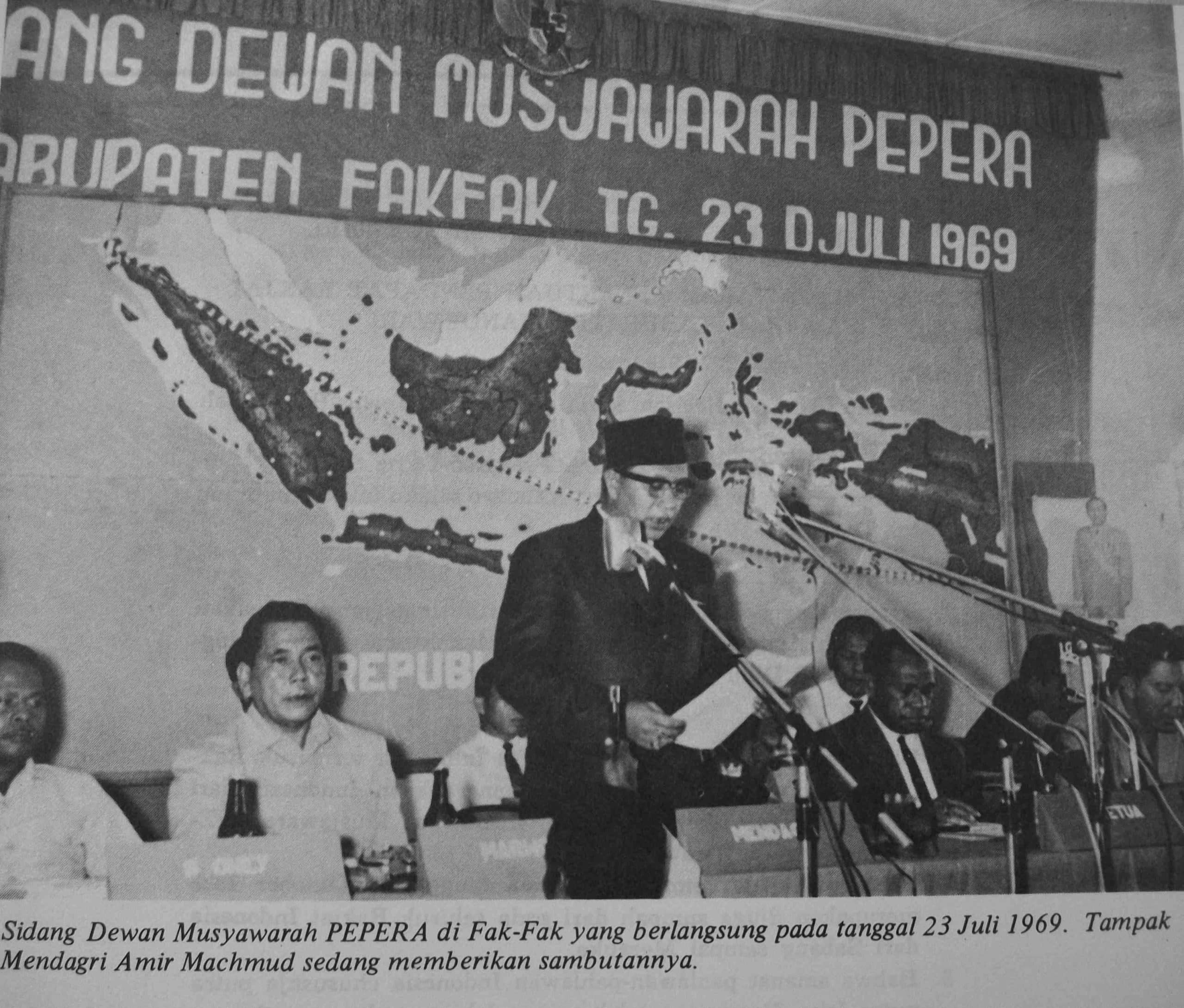
Over six weeks from July to August 1969, U.N. officials conducted the so-called “Act of Free Choice.” Under the articles of the New York Agreement (Article 18) all adult Papuans had the right to participate in an act of self-determination to be carried out in accordance with international practice. Instead, Indonesian authorities selected [1025] West Papuans to vote publicly and unanimously in favor of integration with Indonesia.
The ‘Act of Free Choice’, now habitually referred to as the ‘Act of No Choice’ by Papuan independence advocates, was a farce from beginning to end. The suggestion that almost a million people who had already prepared a flag and an anthem for their imminent independence would unanimously vote for foreign control is derisory.
From New Internationalist:
One of the few journalists there at the time (the world’s media was focused on Indochina), Hugh Lunn, has written an account which records Papuans’ heartfelt and ignored pleas to the outside world. On arriving at his hotel he found a letter soaked in blood which said Indonesia was killing dissenting Papuans. Then a Papuan who came into his room supposedly to repair a light mimed himself being shot in the back of the head while another pretended to be handcuffed. UN staff who spoke to Lunn off-the-record had all experienced but not publicized similar creative requests for international support.
Australia also ignored such pleas. At the request of Indonesia, it arrested two pro-independence activists when they entered Australian-administered Papua New Guinea. They carried testimonies from Papuans calling for independence and for the UN to abandon the Act of Free Choice. These were never delivered – instead the activists were put in jail.
A statement prepared by the US Embassy in Jakarta and presented to Australia before the UN-supervised vote says: ‘Personal political views of the UN team are… 95 per cent of Irianese (West Papuans) support the independence movement and that the Act of Free Choice is a mockery.’
This new evidence confirms that the UN, Australia and the US all knew that the Act of Free Choice was actually what Papuans call the ‘Act of No Choice’. The duplicity is incomprehensible to most Papuans – the UN had embraced many new nations; the US, in its anti-Communist crusade, avowed support for freedom and Australia followed suit. But all these promises and pronouncements were void when it came to their own oppression.
After West Papua was officially proclaimed Indonesian, the small rebel group, Organisasi Papua Merdeka (OPM or Free Papua Movement) although armed only with bows, arrows and spears, provided the Indonesian military with a rationale to clamp down on the province. An estimated 60,000 troops were deployed. From 1967 to 1972 the military violence is estimated to have caused between 30,000 and 100,000 Papuan deaths. Then, in the late 1970s, a series of ceremonies raising the West Papuan flag in the Highlands resulted in the military bombing and strafing of whole villages, killing at least 1,000 people and causing at least 5,000 to flee and hide out in the forest.

To the lasting shame of the United Nations, not only did it knowingly permit this travesty, but its official stance on the Act of Free Choice remains unchanged, making a mockery of its own charter and the idea that it is independent of the influence of powerful nations.
What could explain this turning of a blind eye by the UN? In an astounding coincidence, the largest gold mine and third largest copper mine in the world is located in this region. The Grasberg mine is 90.64% owned by the US mining company, Freeport McMoRan (formerly the Texas Freeport Sulphur Company). By the mid-1980s, with the original mine largely depleted, Freeport explored for other deposits in the area, identifying in 1988 reserves valued at $40 billion at Grasberg just 3 kilometres from the Ertsberg mine. A 2003–2006 boom caused by extra consumption of copper for Asian electrical infrastructure caused prices to increase from around $1500/ton to $8100/ton, greatly increasing the profitability of the mine.
[As a noteworthy aside, in his book The Trial of Henry Kissinger, Christopher Hitchens wrote:
In 1989 Freeport-McMoRan paid Kissinger Associates a retainer of $200,000 and fees of $600,000, not to mention a promise of a 2% commission on future earnings. Freeport-McMoRan also made [Henry] Kissinger a member of its board of directors, at an annual salary of at least $30,000.]
Environmental groups are concerned with the potential for copper contamination and acid mine drainage from the mine tailings into surrounding river systems and groundwater. Concerns are such that both Freeport and its partner Rio Tinto were excluded from the investment portfolio of The Government Pension Fund of Norway, the world’s second-largest pension fund, due to criticism over the environmental damage caused by the Grasberg mine. Stocks at a value of US$870 million were divested from the fund as a result of the decisions.
According to the Free West Papua campaign, ‘Freeport is Indonesia’s biggest taxpayer, making billions of dollars for the Indonesian government every year. The company reportedly pays the Indonesian military around $3 million every year in “protection money”, ensuring that local West Papuans are kept out of the area. The mine reportedly pumps over 238,000 tonnes of toxic waste into the local river system every day, leading to mass fish deaths and swathes of biologically dead lands’.
Unsurprisingly, the human rights situation is horrific, with numerous incidences of torture, rape and murder:
Many towns and villages have witnessed wholesale massacres of their people. One such example was the ‘Biak Massacre’ in 1998, where over 200 people including women and children were rounded up by the Indonesian military, loaded onto vessels, taken to sea and thrown overboard. In 2010 the UK’s Channel Four News broadcast a [graphic] report on torture in the region. In a public report to the U.N. Commission on Human Rights in 1999, the Special Rapporteur on Violence Against Women concluded that the Indonesian security forces used rape “as an instrument of torture and intimidation” in West Papua, and “torture of women detained by the Indonesian security forces was widespread”.
There are currently hundreds of West Papuan political prisoners being held in West Papua and across Indonesia. Many are serving long prison terms for peacefully protesting against Indonesian rule or for being members of organisations calling for West Papuan independence.
Filep Karma is a particular case in point, serving a 15 year jail sentence simply for raising the West Papuan national flag. He is an Amnesty International prisoner of conscience. Conditions in the prisons are often very poor and maltreatment of prisoners is common with many being beaten and tortured while detained. Prisoners have often developed severe health problems and been denied access to medical care.
Many Papuans live in a constant state of fear and intimidation. People living in villages across West Papua can at any time be subject to military sweeping operations. Under the pretence of looking for insurgents, the military have repeatedly swept through entire rural areas killing arbitrarily and burning whole villages to the ground, destroying subsistence food crops and livestock and forcing people to flee into the forests where they are prone to starvation and disease.
West Papua is currently off limits to international journalists. If discovered without permission they are arrested and deported by the Indonesian authorities. Some have even been attacked and imprisoned.
The ongoing tragedy in West Papua is just one more example out of thousands where human welfare is trumped every time by economic, financial and/or geopolitical interests, where the widespread torture, rape and murder of locals are merely PR obstacles. This is an inevitable consequence of the pursuit of profit, the fundamental principle behind capitalism; a system that is antithetical to preservation of the environment and human rights. (*)
The author is writer with a particular focus on human rights, corporate media criticism and democracy.