









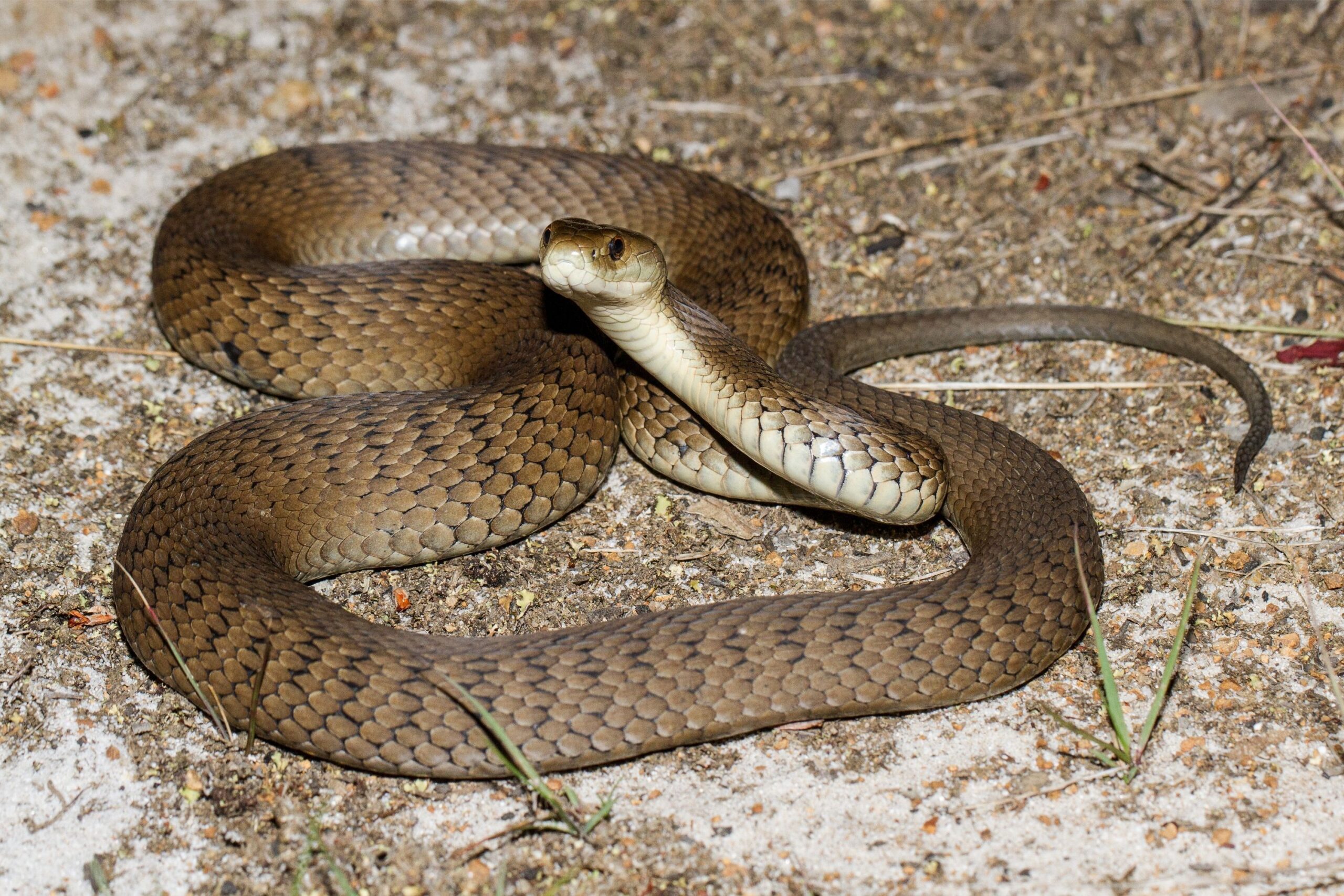
Jayapura, Jubi – Snakes are a type of legless reptile that move by slithering, using contractions of their body muscles along with the help of their belly scales.
These reptiles live in a variety of habitats, ranging from forests to residential areas. Generally, people only know of the King Cobra, recognized as the most dangerous venomous reptile in the world.
However, it turns out that in the Land of Papua there are snakes that are highly venomous and lethal when they bite their prey, including humans.


Prof. Dr. Ronald G. Petocz, in his book Nature Conservation and Development in Papua, writes that snakes in the Land of Papua are quite well represented. They range from venomous black lowland species, Acanthophis antarcticus, to the Papuan Taipan, Oxyuranus scutellatus, which can reach a length of three meters. Venomous snakes as well as non-venomous tree snakes, such as Chondropython viridis, can be found in the natural habitats of the Land of Papua.
The coastal taipan (Oxyuranus scutellatus), also known in English as the coastal taipan or common taipan, is a taipan species widely distributed along the northern and eastern coasts of Australia and the island of New Guinea (Papua, Indonesia, and Papua New Guinea). This snake is the third most deadly venomous land snake in the world.
The three main venomous benchmark species include, first, the Papuan taipan; second, the smooth-scaled snake; and third, the Papua New Guinea small-eyed snake.
The Papuan taipan can be found in warm, humid areas ranging from tropical coastal regions, monsoon forests, sclerophyll forests, open woodlands, as well as grasslands—both natural and man-made—and piles of unused debris. Coastal taipans favor abandoned animal burrows, hollow logs, and piles of vegetation or leaf litter as shelter.
The World Health Organization (WHO) records that around 80,000 to 140,000 people die each year from snakebites.
So how do cases of death from Papuan taipan bites look on the island of New Guinea? Papua New Guinea holds records of Papuan Taipan bite victims at Port Moresby Hospital. 90 percent of severe bite victims who were treated [there are affected by taipan bites].
Reported by Al Jazeera in Papua New Guinea, the Papuan taipan (a close relative of the coastal taipan) is responsible for the majority of severe poisoning cases.
Experts estimate that this snake kills up to 1,000 people each year in the neighboring country, which has a population of 11 million.
This is equivalent to about four deaths per day, making it one of the most deadly snake species in the PNG region.
Meanwhile, in Papua, Indonesia, in Central Papua Province, a member of the Amole task force serving in Papua, Chief Brigadier (Bripka) Desri Sahrondi, once died after being bitten by a death adder. At the time, Bripka Sahroni was guarding his colleagues who were bathing in the Iwaka River.
This snake has also previously killed a young child in the Mapurujaya area, East Mimika District. As well as a housewife named Rostina, a resident of the Asmat Complex, Wania Village, in Mimika Regency, Central Papua Province.
Quoted from the book “Top Ten Deadliest Snakes In The World,” the death adder is classified as one of the dangerous snake species because it possesses a fast-acting, highly lethal neurotoxic venom.
The venom from a death adder bite can trigger paralysis, ultimately shutting down respiratory function entirely. A death adder bite can also cause death within as little as six hours if not treated medically right away.
It is estimated that around 1,000 people die each year from snakebites. Diana Barr of the Australian Venom Research Unit at the University of Melbourne said that deaths from snakebites are one of the most neglected causes of death in the country. In addition, according to Biomedical Sciences at the University of Melbourne, snakebites remain a significant problem in PNG, and World Health Organization data states that around 1,000 deaths from snakebites are reported every year.
The species most frequently responsible for snakebites is the Papuan taipan. The Papuan taipan is commonly found in the coastal savanna grasslands of southern PNG. It predominates in Central Province, the National Capital District (NCD), Milne Bay Province, the eastern part of Gulf Province, as well as the South Fly and Middle Fly regions of Western Province, but is not found in other regions of PNG.
Deadly venomous snakes are found in all mainland provinces and are the most common cause of poisoning and death outside the southern coastal provinces. (*)