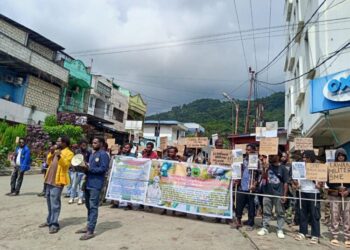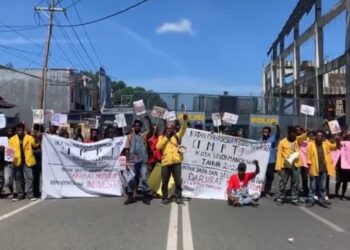










Jayapura, Jubi – Benhur Wally, the chairperson of the Jayapura chapter of the Indigenous Peoples Alliance of the Archipelago (AMAN) expressed concerns about the shrinking space for the freedom of expression for Indigenous Peoples in Papua.
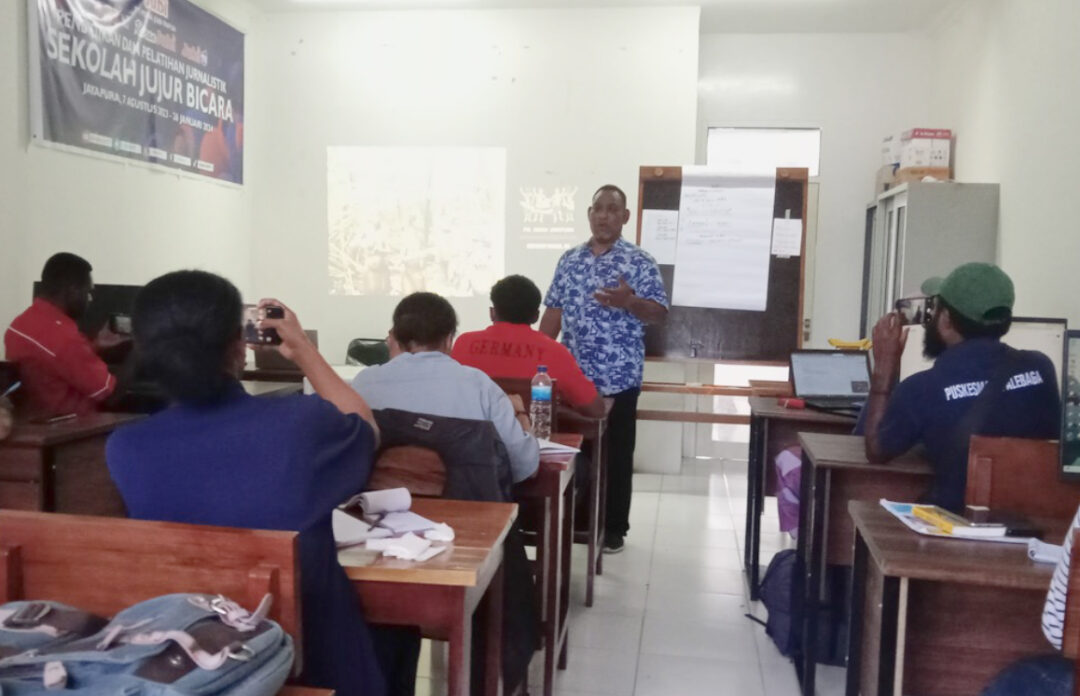
Wally highlighted the restricted environment for indigenous communities, which he attributed to policies enforced by the central government. During a presentation on Indigenous Peoples in Papua for prospective Jubi reporters in Jayapura City, Wally pointed out several central government policies affecting customary land ownership rights. These policies include government-led land clearing and the implementation of dependency systems through village funds, which make citizens highly reliant on the government.
Wally emphasized the diverse nature of Indigenous Peoples in Papua, each with their unique customs and beliefs, and stressed the need for specific regulations to safeguard their rights throughout Papua and the entire archipelago. He called for comprehensive legal provisions that legitimize the rights of all Indigenous Peoples in Indonesia.

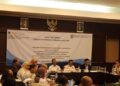
Wally also underlined that the term “Indigenous Peoples” is not foreign to Indonesia, as the country has a substantial Indigenous Peoples population estimated to be between 40 to 70 million people, with 20 million being members of AMAN.
Unfortunately, due to their minority status, Indigenous Peoples often face stigma, violence, intimidation, and criminalization.
Wally concluded that the Constitution’s current provisions do not grant Indigenous Peoples the freedom to independently manage and govern their customary forests.
This is because, he elaborated, Article 33, paragraph 3 of the Constitution serves as a means to grant foreign companies or individuals the freedom to cultivate crops on indigenous lands when the need arises within the archipelago.
Regarding the term and identity of indigenous peoples, AMAN aligns with the globally recognized concept of “indigenous people.” Indigenous Peoples are communities that have a longstanding history of origin and have inhabited customary territories for generations. They exercise authority over these lands and natural resources and lead a socio-cultural life guided by customary law, with customary institutions responsible for sustaining the way of life of Indigenous Peoples as customary communities.
There are four essential elements that distinguish Indigenous Peoples from other social groups. These components include a shared cultural identity, encompassing language, spirituality, values, and distinctive behaviors that differentiate one community from another. Additionally, they possess a value and knowledge system, which includes traditional wisdom, spanning traditional medicine, farming, games, schools, and various other traditional knowledge and innovations.
Furthermore, customary territories encompass land, forests, seas, and other natural resources. These resources hold significance not only as economic assets but also in religious and socio-cultural contexts, alongside the framework of customary law and institutions. These components also encompass regulations and governance to facilitate the collective organization and management of their social, cultural, economic, and political life.
Furthermore, according to Wally, drawing on the United Nations (UN) Declaration on the Rights of Indigenous Peoples (UNDRIP), the defining characteristics of indigenous peoples encompass self-identification, historical continuity dating back to a time before colonial or imperial invasions, an original population with a unique history, a spiritual connection to customary land and territory, a distinctive identity based on language, culture, and beliefs, and distinct socio-political and economic systems.
Internationally, prior to the establishment of UNDRIP, the 1989 Indigenous Peoples Convention, also known as International Labour Organization (ILO) Convention No. 169, was the initial international instrument to acknowledge Indigenous Peoples. This Convention, adopted by member states of the International Labor Organization in 1989, sought to update ILO Convention No. 107, the 1957 Indigenous Peoples Convention.
“The primary principle of the convention is the protection of Indigenous Peoples’ way of life, culture, traditions, and customs,” he explained.
He emphasized that the fundamental right of origin is another key factor that clearly sets indigenous peoples apart from kingdoms or sultanates. Kingdoms or sultanates are traditional state concepts, and indigenous peoples differ significantly from these.
From the outset, Wally explained that Indonesia has recognized the status of indigenous peoples through the 1945 Constitution. This recognition and respect for Indigenous Peoples is clearly articulated in Article 18B, paragraph 2, and Article 28I, paragraph 3.
Article 18B acknowledges that the state acknowledges and respects the unity of customary law communities and their traditional rights as long as these rights persist and are in harmony with the evolving society and the principles of the Unitary State of the Republic of Indonesia.
Article 28I, paragraph 3, highlights that the cultural identity and rights of traditional communities are respected in accordance with the progress of the times and civilization.
Wally also pointed out that Indonesia employs various terms in different narratives and legal documents, including ‘Masyarakat Hukum Adat’ (Customary Law Community), ‘local community,’ ‘traditional community,’ ‘Komunitas Adat Terpencil (KTA)’ (Remote Indigenous Communities), and ‘indigenous people.’
The term ‘local community,’ for instance, is used to describe the ‘nagari’ in the Minangkabau indigenous community in West Sumatra or the ‘clan’ in the Batak indigenous community in North Sumatra. Similarly, the indigenous Papuans refer to ‘tribe and clan’ in Papua and West Papua.
These designations can also refer to local communities and not necessarily Indigenous Peoples in contexts such as Java or immigrant communities (transmigration villages) that have lived in an area for generations, particularly when the designations do not account for language identity, genealogical connections, or territorial ties related to their heritage of origin as distinguishing factors. (*)